
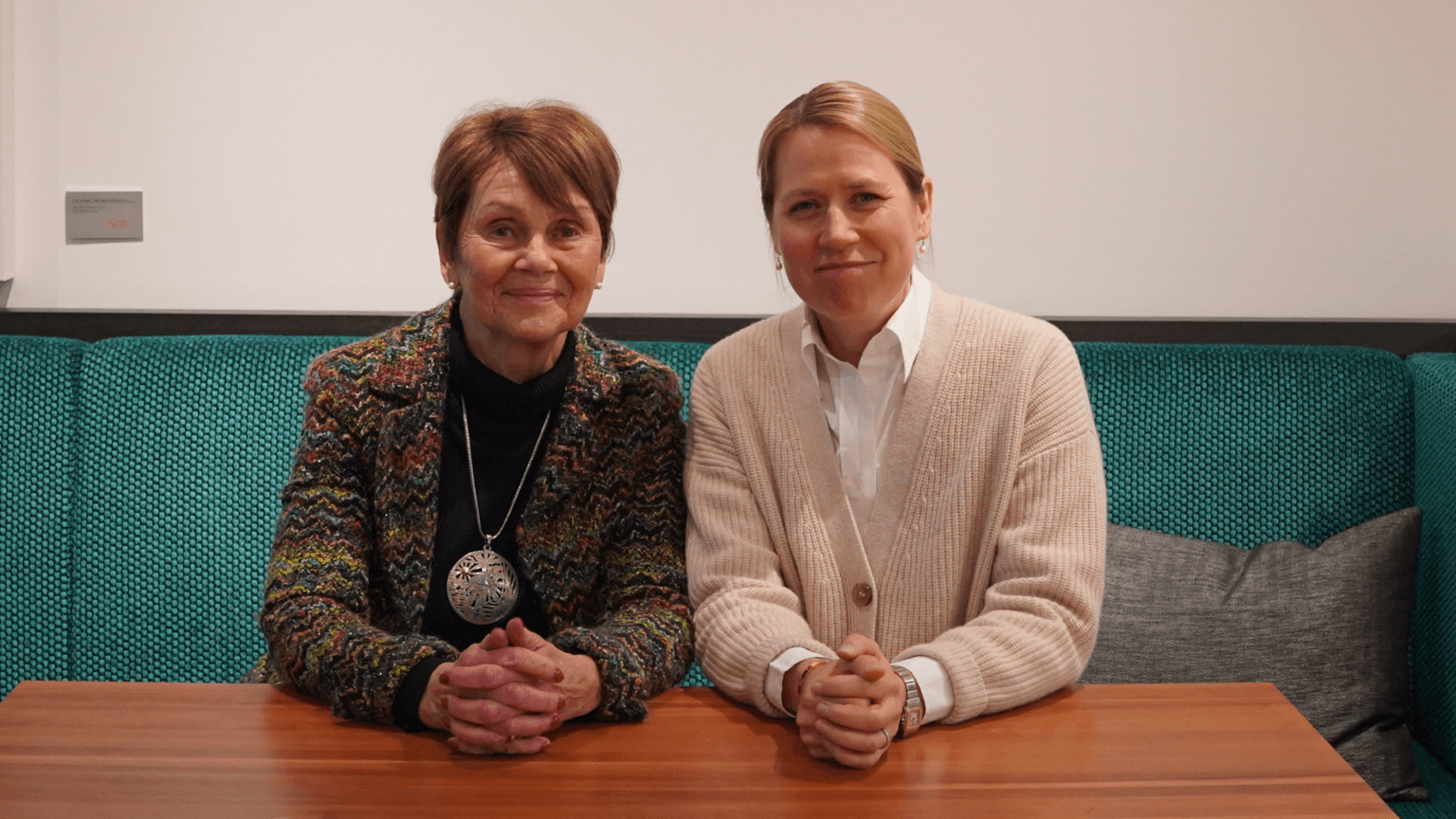
When HM The Queen founded Childhood in 1999, a dedicated network of donors stepped forward. Two of them were Jane and Dan Olsson. For Jane, it marked the beginning of more than two decades of engagement with the organization — an engagement that has now been carried forward by her daughter-in-law, Kim Olsson.
Child sexual abuse was, to say the least, a sensitive issue in 1999, and many questioned the Queen’s decision to start an organization. What made Jane and Dan decide to invest?
– Through my work as a gynecologist, I met women who had been subjected to sexual abuse. I saw the consequences and knew that children were also affected. Joining Childhood therefore felt extremely important. It became an opportunity to make a positive difference, says Jane, continuing: From the very beginning, Childhood had an incredible network. Not least the Queen herself, but also dedicated individuals like Sven-Philip Sörensen, who truly fought to bring others on board.
From a small office in Kungsträdgården in Stockholm, with a board of just a few members, the first Secretary General Gunilla von Arbin, and a couple of staff members, the work began to realize the Queen’s vision and build Childhood into the global child rights organization it is today.
– t has been an incredible journey to be part of. We began working in Eastern Europe. Even though we were small and newly established, we were able to reach people there thanks to an existing network that helped us bring attention to the issue and broaden our connections, says Jane.
Over time, the work expanded to other countries where safety nets for children were few and vulnerability was high. At the same time, local foundations were established in Brazil, Germany, and the United States.
– Since the beginning, Childhood has been a nimble, flexible, and courageous organization willing to step in first and test new ideas. I also think it’s important to highlight how deliberately the organization has worked to raise awareness about child sexual abuse, both in Sweden and globally, says Jane.
Scouting and investing early in small projects with the potential to scale up is part of Childhood’s DNA. In other words: test a method on a small scale, evaluate it, and then spread it further with the ambition that others will take it forward and that more children will be reached. One example Jane remembers in particular concerns newborn girls in China who were left on the streets and ended up in orphanages.
– It was terrible. Together with an American organization, we launched a local project where the girls received education, a ‘parent’ who followed them, and support to integrate into society. The method was later adopted by the Chinese government and spread throughout the country. It made a real difference for so many girls, and it’s something I carry with me. Right now, I also feel especially proud of the impact Childhood’s efforts in Ukraine are having for our partners and, above all, for the children, says Jane, adding that the project trips have left the deepest impressions over the years.
In the fall of 2023, Jane, together with the Queen, members of the board, and Childhood staff, met Ukrainian partners in Poland. Kim was also part of that trip.
– Ukraine is truly a strong example of Childhood’s power to create change. I would also highlight Barnahus and the spread of that model over time. And Childhood’s systematic work to integrate the child perspective into everything we do,” says Kim.
After 24 years on the board, seven of them as chair, Jane passed the role to Kim in 2023. What is it like today to follow Childhood from the sidelines?
– Strange and a little empty. I miss it. But it was the right time to step down. Everything was working well, and I felt I could no longer contribute much more. It was time to make room for a new generation. It was natural that Kim would take over as the representative of the family and Stena, says Jane.
Was it just as natural to you, Kim?
– Absolutely. It felt very meaningful to take over and learn more about the organization, but also to see how I, with my background, can contribute. If you’re involved, you should give it your all, says Kim, who is CEO of Stena Sessan Fastighets AB.
How does board work at Childhood differ from serving on a corporate board?
– If the driving force in companies is profit, the driving force in Childhood is impact for children. At the same time, we share the same focus on success, organizational development, and the well-being of employees, says Kim.
And the commitment does not stop at the boardroom.
– We wanted to show others that supporting Childhood is important and also beneficial for us as a company. Social engagement and business value go hand in hand. It’s also rewarding to collaborate with other partners, says Kim, highlighting the business lunch that she and Jessica Span from Volvo Car Sweden hosted in Gothenburg to inspire others.
Finally—why should others invest in Childhood?
– Because it’s a serious, transparent, and effective organization that makes a real difference for children,” says Kim, with Jane adding: It’s an organization of a size where, as a donor, you truly have the opportunity to make an impact.
CO-FOUNDERS
When Childhood was founded in 1999, 14 foundations, philanthropists, and companies each contributed USD 1 million. Their investments form Childhood’s endowment, the returns of which are used to cover administrative costs. Most of our co-founders have maintained a long-term commitment since the organization was founded, beyond their financial support:
ABB
Axel Johnson
Charles B. Wang Foundation
Curtis L. Carlson Family Foundation
Daimler Corporation Fund
Barbor E. Heinz family
Jan H. Stenbeck family
Jane och Dan Olsson family
Heimbold Foundation
Oriflame – af Jochnick family
SAP
Skandia
Telia Company


